
ROBERT BOLLA
**EMERALD ARTIST OF THE YEAR 2024**
Robert Bolla was named the RUBY ARTIST OF MARCH,
the EMERALD ARTIST OF JULY, the EMERALD ARTIST OF OCTOBER
and the CRYSTAL ARTIST OF NOVEMBER 2024.
These achievements granted him entry into the 4th, Annual ARTISTS OF THE YEAR EVENT
where he was then named the EMERALD ARTIST OF THE YEAR 2024.
You are invited to come and meet this inventive photographer — discover his distinctive artistic statement
which uses an interesting motif and creates a captivating pop art and poster effect
in his series dedicated to musicians and learn about his impressive scientific background
and how this unlikely field gradually led him to art — right here in the following feature and interview
which was created in recognition and celebration of his EMERALD ARTIST OF THE YEAR 2024 title.

“Having spent a long career writing the written word and holding the idea of a picture of what I write, I decided upon retirement I would turn to using photography to write a novel — or just to tell a story — while showing that there is a close relationship between the arts and sciences.”
Robert Bolla lives in St. Louis after retiring from a 40+ year academic career as a biologist. He is self-trained as a photographer with some mentoring in film. He used photography and micro photography in his teaching and research. Robert’s photographic interests are many but primarily lie in nature, landscape and ethnographic photography relating science and the arts. He uses the digital darkroom to enhance his photographs via digital painting. Robert has exhibited in solo exhibitions including in Poznan, Poland at the EuroBiotech Conference, Peoria Artist Guild, Bradley University, St. Louis Public Library and St. Louis Artist Guild. His work is often included in competitive juried art exhibitions in St. Louis as well as in national and international juried competitions.
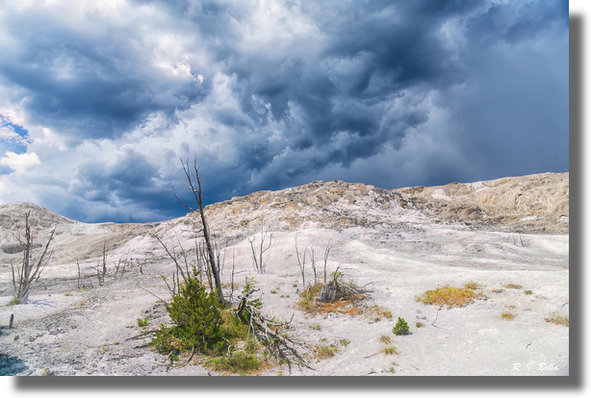
* Death Valley *
Photography
GR — You have a very impressive background in a field not related to art in any obvious way — BA in biology, Ph.D in Zoology/Parasitology, 30 years teaching biological chemistry, Fellow of the Japan Society for the Advancement of Science, Dean of two universities — it seems most unlikely and surprising that you found your way to art. How did this happen?
RB — How I found my way into art, particularly photographic art, describes my background in a different way but enmeshes my career in science with an underlying pinning in art. In my freshman year in college, I was certified as a medical laboratory technician. In the following summer I took a job as a lab/morgue tech in a state hospital complex. One of the techs in the lab was a professional wildlife photographer and down the hall in publications was a wedding photographer. Since we all had some down time, they told me to get a good 35mm camera and they would teach me photography. We had a dark room in the morgue and they had all types of cameras from glass plate to bellows to the most modern. I took pictures and they taught darkroom techniques; I fell in love with playing in the darkroom. This morphed into a second summer job there with more of the same before I left the lab for other adventures. In my last year of college before going to graduate school I was employed as a pollution chemist for New York State and in this role worked in the field documenting pollution events both through chemistry and visually with photographs for legal purposes. So, by the time I began my academic career I had walked in the world of photography where I had developed an eye for the visual story. Because of the rigors of graduate school my photographic efforts were reduced to family photos. As my academic career moved along, photography for other than a tool in research became almost forgotten and the camera rarely came out. Days of photographing chromosomes in tiny worms, days of electron microscopy or days of using photographic image analysis to verify our scientific hypotheses left little interest in picking up the camera for fun or art other than when I traveled or when I needed material to enhance my teaching. My path to photographic art does not end here. After retirement my wife and I stopped by a photographic show sponsored by a local community art association. I spent time talking with one of the organizers of the show who enticed me to tell him about my background. A few days later I was invited to join the board of trustees of this organization where I was asked to use my academic career experience to write grants and raise funds. On the board I was surrounded by not only visual artists but performing artists as well. In passing, one of the other members of the board asked about my art and I told her maybe photography. Well, she said there was a juried multimedia competitive show coming up for folks over 60 and maybe I would like to submit a piece. I did and had work accepted and from there my art career jumped out at me. I fell in love with the chance to show my work and with the competition which I could use as a platform to improve.
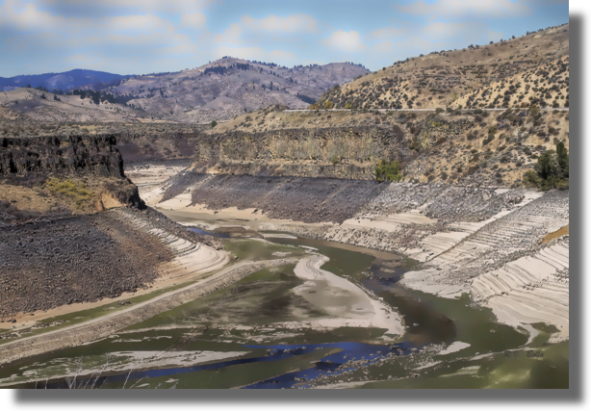
* The Snake River Runs Through It *
Photography
GR — During your research as a biologist, you had to use microphotography for chromosomes and photo radiography for cellular biochemistry. What are the similarities to the technical equipment and process you use now?
RB — The methods I used for research are far afield from what I do now. Microphotography required photography using a camera back attached to a microscope to enhance the image involved in the study. Autoradiography has similarities with wet plate photography I had learned earlier. In this technique tissue sections from the experimental plant or animal exposed to radioactive precursors for a cellular reaction are affixed to a glass slide and then the slide is coated with a photographic emulsion to develop an image of the cellular reaction in the sections of cells on the slide. A bit of a reverse of wet plate photography but having such an experience earlier was to my advantage.
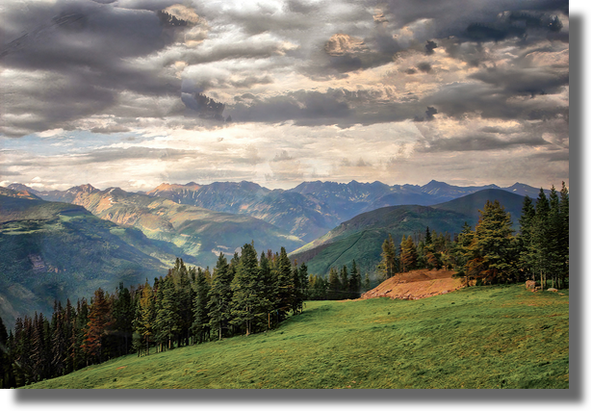
* Elk Mountain Range, Rocky Mountains *
Photography
GR — You say it took you a while to realize there is a relationship between art and science — can you describe this relationship you have discovered? How would you say science participates in your images and how did it prepare you for your artistic career?
RB — This comes with a story. As I worked through my graduate career and into research fellowship positions, I gave little thought that what I did in science might find a relationship in art. One of my early post graduate positions was as a research fellow at the Roche Institute of Molecular Biology, a research institute packed with some of the brightest minds in science, minds that thought beyond the bench and research. As it would have it some of us would gather for lunch in a group that included a noble laurate responsible for describing the genetic code. Seldom would science be the topic of the day but rather, we would talk about how art, science and society meshed. Thus, for example we saw how the “art” of the DNA helix expressed the science the helix controlled. From here, I was pushed to looking at what Leonardo da Vinci did and said about his work, where scientific principles formed many of his concepts for art. It became clear to me that nature shaped the artistic world we see around us or at least the natural world. The design of a tree, of an animal or of a human is formed by nature but is an artistic expression needed for evolutionary survival. I carried these thoughts along over the years. My first solo photographic exhibition was based on using photography to depict evolutionary comparisons. As I wander about with the camera now, I look for how nature expresses what one defines as art or how art tells us something of nature. A painting, drawing or photograph of a child and mother or father while art also tells us about the science of life. Thus, as my interests have moved to ethnographic photography but not abandoning nature and landscape photography, I have begun focusing on the art of the human and how this shows similarities of societies and people as they follow their path of everyday life. I have interests in nature and landscape photography that allows the viewer to see and think about the evolution of the environment.
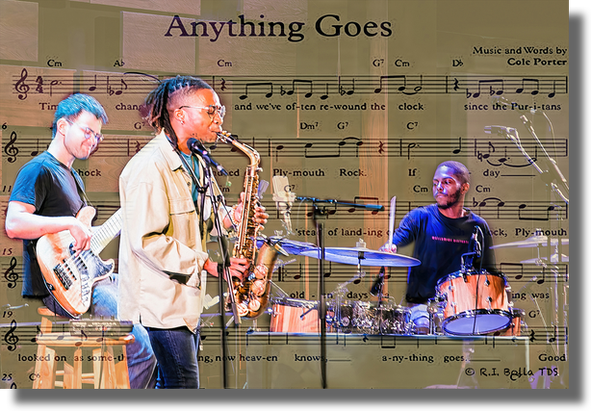
* Scooter Brown Trio - Then There Was Jazz *
Digital photo composite
GR — Musicians often appear as subjects in your work. Their lifestyles are considered wild, free and exciting — adjectives not commonly associated with scientific research and laboratories. Is it this contrast which attracts you to them as your subjects?
RB — I volunteer at Jazz St. Louis Bistro (jazzstl.org) and have access to the performances and educational events that take place there. I often get to meet the musicians and listen to their stories. They tell me of the grind of gig playing and their love of expression of their art and I get to watch the formation of future jazz musicians through Jazz U — the educational effort of JazzStL.org. As an aside — Scooter Brown is one of these students whom I have known from his beginning as a student to now as an internationally recognized performer. I see these musicians in light of an ethnography that is underpinned by the science of the music and of how their art is brought out through the instrument they have in hand. I think this might be best seen in the photograph of Grace Kelly playing the saxophone as she puts her whole being and feeling into the musical notes she is coxing forth. While some may think their lifestyles are wild, free and exciting, I see them as working artists expressing themselves in the world as they define it. They have a job in society that is in many ways no different than that of a doctor, lawyer, teacher, carpenter or office assistant.
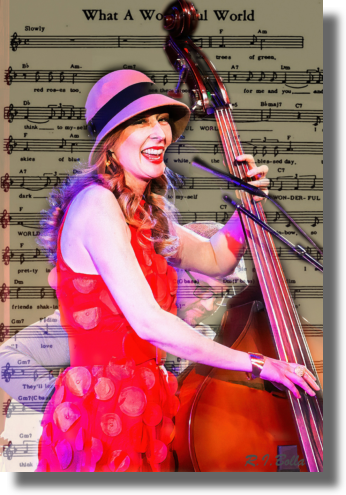
* The Jazz Singer Janet Evra *
Digital photo composite
GR — The inclusion of sheet music in your images produces a surreal, poster effect as it flattens and pushes away the background and extraneous information and gives the musicians an almost sculptural, glowing and statuesque quality. What is your intention with this artistic technique and how did it come to be?
RB — As I have noted my goal in my photograph is to tell a story and in the case of the musicians, they are the story. In addition, I noted my interest in ethnographic photography and again this makes the person or persons the focus of my photo. How did I come about this artistic technique reaches back to the late 1800’s and glass plates used as negatives/positives. With digital photography the expression is “anyone can take a picture” and yes that is true — but how one “takes” or interprets the picture in post-production is an expression of how one sees photography. As I started my “retirement career”, I began to search historical photographic methods and came across Edward Curtis’s work in the late 1800’s and early 1900’s. Curtis had a project to photograph native Americans as they were driven from their lands. Curtis looked for a way to bring the image out of the background to become the focal point of his photograph. To do this he developed the orotype or gold type. In this method he painted the back of his glass plate negative with a solution of 24 carat gold and printed from there. As I thought about the musician preforming his or her art, I realized that I could not only exemplify the art but could use the music to occlude the background that distracted from the main subject of the photo in much the way Curtis used the gold tone technique. As an aside I have ethnographic photographic projects that are based on gold type prints to show such as FACES OF SOUTH AFRICA.
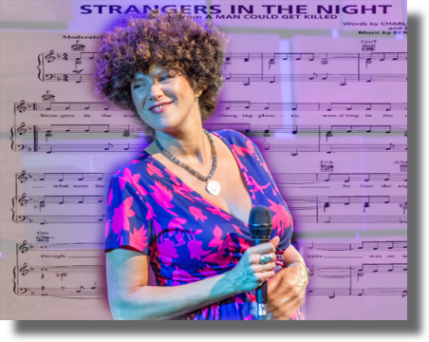
* Cyrille Amiee - The Jazz Singer *
Digital photo composite
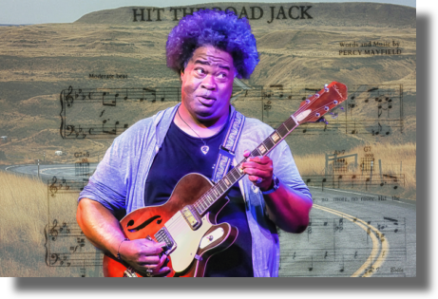
* So I Missed A Chord, Then Hit The Road Jack *
Digital photo composite
GR — Are these images part of a series? Is there any particular meaning behind the songs chosen and do they represent what was being performed at the time the images were taken?
RB — Yes, I have begun a series project with these images focusing on the expression of jazz to show the art of music in society. Many of the songs behind the images are picked randomly, some of those performed by the musician and others to give the photo a comic look or story. For example in SO I MISSED A CHORD, THEN HIT THE ROAD JACK — the expression of the musician seems to be saying to the audience that he knows what he wants to do.
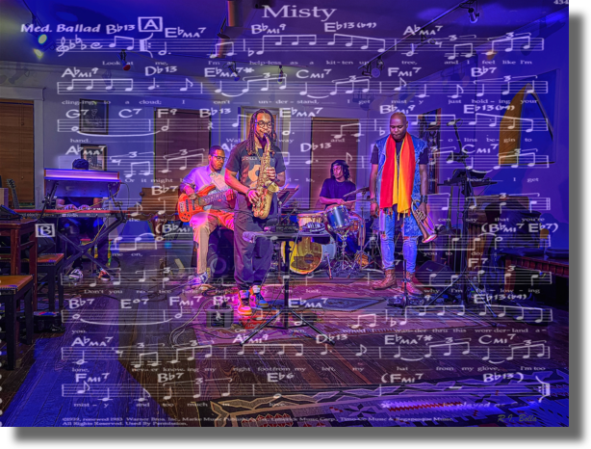
* Scooter Brown Quartet Jazz Is Where You Find It *
Digital photo composite
GR — Unlike the others, the musical notation in SCOOTER BROWN QUARTET JAZZ IS WHERE YOU FIND IT is white and proceeds toward the viewer giving the impression that the musicians are existing inside of it. What inspired the change and what was your desired response from the viewers?
RB — This photo was taken in a very eclectic location — a room above a very popular bar and restaurant replete with antique instruments including a gramophone. It gave the impression of a storage room from the 50s and 60s which might be a gathering place for musicians to drop by and play. I wanted to give the mood that this scene was different and that it expressed a time gone by in which jazz encompassed the musicians who themselves were lost in the music.
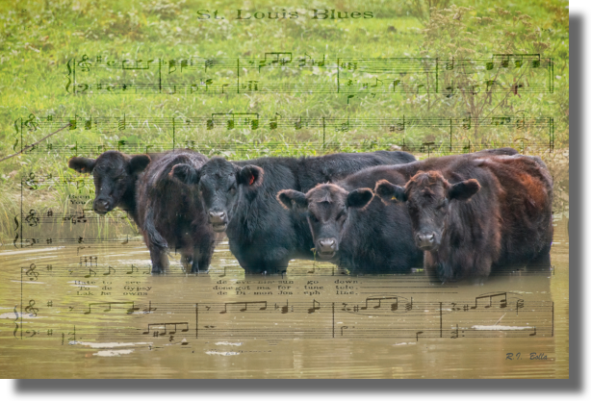
* Muddy Pond Quartet Singing The Blues *
Digital photo composite
GR — A sense of humor is evident in MUDDY POND QUARTER SINGING THE BLUES. What is the story behind this adorable image?
RB — Ah, the MUDDY POND QUARTET — I grew up in a rural area where one might say there were more cows than people. I became enamored with images of cattle breeds and enjoy photographing such for a project series. We live in the country and just around the corner is this farm raising Black Angus cattle. There is a large pond on the land and on the day I shot this photo the pond was covered with green scum, the cattle had just waded in and were just there looking at me. My thought was this is the local Angus choir lined up and eager to sing to me as I took their photo. Remember I want my photo to tell a story and if it is a humorous story then so be it.
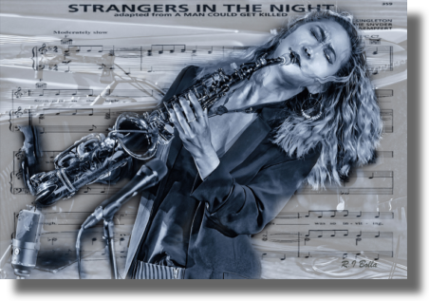
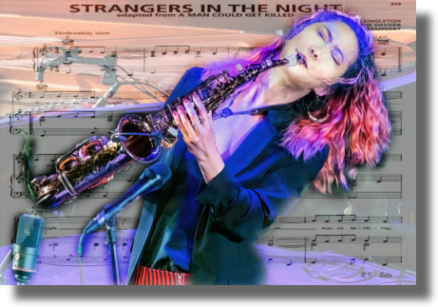
* Grace Kelly Saxophonist With Feeling *
Digital photo composite
* Grace Kelly With Feeling *
Digital photo composite
GR — What prompted you to produce two versions of Grace Kelly with the saxophone? Was this a deliberate colour experiment from the beginning or did the first one inspire the second? What was the process and inspiration that led to these striking images?
RB — In the digital world there are many ways to post process the image and how one does it adds a different expression or maybe story to the photo. This was indeed a deliberate and planned colour experiment as I wanted to see how the silver toned black and white image might tell the story differently from that seen in the coloured image where the background defined the story. These photos are shot in a performance venue where coloured spotlights are used and are varied throughout with more than one coloured light being used at a time. It is very difficult to draw out the meaning of the image from background lighting so yes, I often experiment looking for the image that best tells the story. In this image the expression of Grace Kelly, the feeling she is putting into her performance is the story.
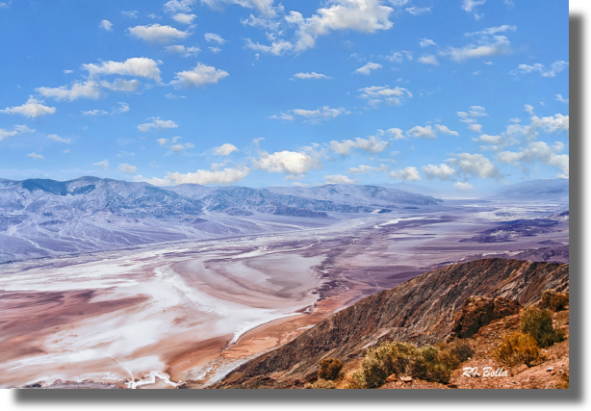
* Death Valley Dry Lake *
Photography
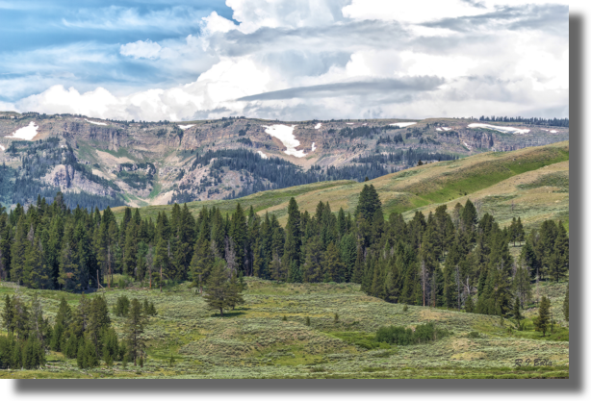
* To Wander The Land Of The Sioux *
Photography
GR — You have many photographs of breathtaking, spacious and monumental landscapes which offer an undeniable feeling of freedom and escape — things again uncommon with a science lab. Do you feel this contrast is responsible for your interest in this subject? How do these images counter or enhance your relationship with science?
RB — Landscape images tell the relationship of science and art — art that is created by nature and science that is built upon the artifacts within the landscape. And yes, a day in the lab often asks for a day in the open world looking at nature and the natural evolution of the environment. Again, I want the viewer to see a story in the landscape and maybe answer the question “if I were a pioneer walking about what would I think of this vista?”. There is a world out there and I try to make my viewers see and think about this world. “How and why is it created in this way? What is life like in the mountains or fields and why does such need protection from destruction through man-made incursions?”. “Why does the vista make one feel free and want to explore?”.
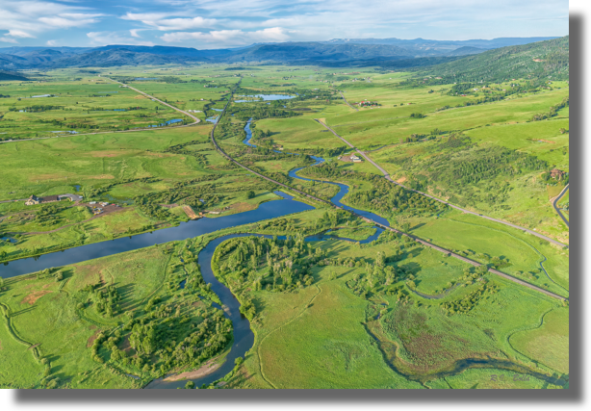
* Mountain Valley Life *
Photography
GR — It has been wonderful to visit with you and to learn about the unusual path which led to your unique and intriguing photographs. Thank you for sharing your stories and congratulations on winning EMERALD ARTIST OF THE YEAR 2024.
RB — I am honoured to be selected as Emerald Artist of the Year and appreciate Gallery Ring for selecting me. One often thinks of a scientist as someone with a narrow focus on what is in the lab or classroom, however during my long career I have always reached beyond, looking for what makes science an art and art a science. I have been told that my mind never stops wandering and maybe that is true but photography has given me a means of writing that classic novel, of teaching outside of the classroom and exploring beyond the bench. I also want to send the word that retirement is not the end of one’s walk through life but really may be the case as Yogi Berra said, “if you come to a fork in the road, take it”.
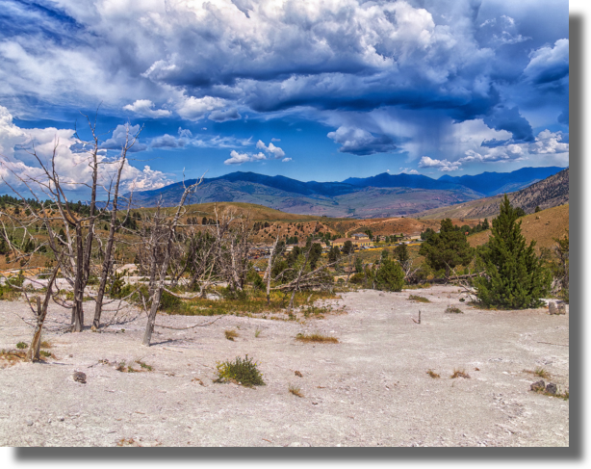
* Jupiter's Cycle Yellowstone *
Photography